As 2026 approaches, food manufacturers are facing a new wave of change—from tougher sustainability expectations and evolving packaging regulations to AI-enabled automation and pressure for flexible, small-batch runs. Outdated filling and sealing equipment makes it harder to keep up, forcing plants into costly retrofits, manual workarounds, or missed opportunities with retailers and foodservice partners. Future-proofing your operation now means investing in machinery that can adapt to new materials, new data requirements, and new product formats without sacrificing uptime.
Custom-built rotary fillers, inline sealers, and tray systems give processors a path to meet these demands while staying compliant with FDA and USDA standards. By designing equipment around your product mix, hygiene requirements, and long-term capacity goals, you can avoid being locked into a rigid machine that becomes obsolete when regulations or packaging formats shift. This guide highlights five key 2026 food packaging trends and how custom machinery can position your plant ahead of the curve.
Trend 1: Rise of Recyclable Materials and Low-Waste Sealing
Across retail and foodservice, brands are moving away from difficult-to-recycle structures and toward clearer, simpler packaging that supports corporate sustainability goals. That often means lighter-gauge films, mono-material structures, and recyclable trays that behave differently under heat and pressure than legacy materials. Inline sealers and tray sealers designed for yesterday’s laminates may struggle to maintain seal integrity, especially when you combine high speeds with tamper-evident requirements.
Custom machinery allows you to adapt sealing heads, dwell times, and pressure controls to the specific recyclable films and trays your customers expect. Engineering teams can design tooling and carriers that support:
- Consistent, tamper-evident seals on recyclable or compostable substrates.
- Optimized cut patterns that reduce film scrap and edge waste.
- Flexible changeovers between standard and “eco” SKUs without major rework.
By building in the ability to run low-waste, tamper-evident formats now, you avoid scrambling to retrofit sealing systems after a major customer announces new sustainability standards. Your line is ready to qualify new materials quickly, with less trial-and-error downtime.
Trend 2: Automation Integration and Smart Rotary Systems
The next generation of food packaging lines will be increasingly data-driven, using sensors, networked controls, and analytics to keep uptime high and labor requirements manageable. Rotary filling and sealing systems are prime candidates for this shift, because even small improvements in speed and reliability can have outsized impact on total plant throughput. Manual checks and paper logs are giving way to dashboards, alerts, and remote support.
Custom rotary systems designed for modern automation can incorporate:
- Smart sensors for temperature, pressure, vacuum, torque, and vibration.
- Networked controls that connect to plant systems for real-time monitoring.
- Remote diagnostics and recipe management to reduce on-site troubleshooting time.
Instead of treating automation as an add-on, a custom build integrates data and connectivity from the start so maintenance, quality, and operations all see the same live information. That means earlier detection of wear, faster root-cause analysis when issues arise, and more predictable performance during critical runs. For plants facing labor constraints, smart rotary machines also support simpler operator interfaces and guided changeovers, reducing training time for new team members.
Trend 3: Hygiene Evolution and Next-Gen Sanitation
Regulators, retailers, and brand owners are not loosening their expectations around food safety—if anything, traceability and hygienic design requirements are tightening. At the same time, more processors are introducing higher-risk products that demand rigorous sanitation between runs. Traditional equipment with difficult-to-clean frames, flat surfaces, and hidden niches makes it harder to keep up with next-generation hygiene standards.
Custom machinery built with hygiene at the core improves both safety and efficiency. Modern stainless steel designs can emphasize:
- Open, accessible frames with minimal harbor points for product buildup.
- Sloped, self-draining surfaces and guarded cable routing to prevent pooling water.
- Tool-less disassembly of key product-contact components for fast, complete cleaning.
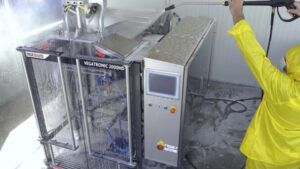
When sanitation is built into the design, you can shorten washdown time without cutting corners. That becomes especially important as plants move to more frequent allergen changeovers, more complex product portfolios, and increased documentation requirements. A custom machine can also align with your specific cleaning chemistry, water pressure, and sanitation workflow, rather than forcing your team to adapt to a generic layout.
Trend 4: Scalable Solutions for E-Commerce and Portioned Foods
Direct-to-consumer and e-commerce-driven food programs are no longer niche. Subscription meal kits, refrigerated snack packs, high-protein cups, and single-serve meals continue to gain traction. These channels often require:
- Smaller fill volumes and portion-controlled containers.
- More frequent SKU changes and seasonal offerings.
- Packaging that survives parcel networks and last-mile logistics.
Legacy equipment designed purely for long, unbroken runs of a few SKUs can struggle in this environment. Custom machinery can be engineered to handle both your current core products and the smaller, more varied runs that e-commerce and club channels demand. This might include:
- Rotary or inline systems with flexible cup and tray size ranges and modular lanes.
- Quick-change tooling and carriers tuned for small-batch runs without significant downtime.
- Integration with case packing, accumulation, and labeling tailored for mixed-case or variety-pack formats.
By planning for this scalability up front, you avoid over- or under-sizing your machines. Your line can start with a modest number of SKUs and volumes, then scale up with additional heads, lanes, or ancillary equipment as e-commerce and portioned product demand grows.
Trend 5: Calculating ROI on Custom Upgrades
Custom machinery can look more expensive on paper than off-the-shelf solutions or patchwork retrofits, but the true cost picture shifts when you factor in downtime, labor, scrap, and compliance risk. For many food manufacturers, a well-designed custom rotary filler, inline sealer, or tray system can pay for itself in 12–18 months.
When evaluating the business case, consider:
- Throughput gains: Additional units per hour or per shift from optimized changeovers, automation, and better material handling.
- Labor savings: Reduced manual loading, rework, or offline coding through integrated denesters, coders, conveyors, and accumulation tables.
- Scrap and giveaway reduction: Lower film, product, and packaging waste with improved filling accuracy and consistent seals on modern materials.
- Downtime and risk: The cost of outages caused by hard-to-source parts, outdated controls, or sanitation issues—especially during peak periods.
A simple ROI model that aggregates these factors often shows that a custom upgrade is not just a technical improvement, but a financial one. The key is to base your projections on realistic line data—current speeds, changeover time, labor allocation, and scrap rates—so decision makers can see how custom equipment affects the P&L over the next 12–18 months and beyond.
Simple 2026 Trend Impact Table
| 2026 Trend | Operational Impact | Custom Machinery Focus |
| Recyclable, low-waste materials | New sealing behavior and scrap risk | Tooling, seal control, film optimization |
| Smart automation and IoT | Need for real-time data and uptime | Sensors, networked controls, remote diagnostics |
| Advanced hygiene expectations | Faster, deeper sanitation requirements | Open frames, stainless design, easy washdown |
| E-commerce and portioned foods | More SKUs, smaller runs, flexible formats | Quick-change, scalable lanes, integrated flow |
| ROI-driven capital planning | Pressure to prove payback in 12–18 months | Throughput, labor, and scrap savings |
Bring Your 2026 Packaging Strategy to Life
The plants that will thrive in 2026 are the ones treating these trends as design inputs, not last-minute problems. By aligning your next rotary filler, inline sealer, or tray sealing system with recyclable materials, smart automation, advanced hygiene, and scalable formats, you can future-proof your operation against shifting regulations and market demands.
If you are reviewing capital plans or compliance priorities for the coming year, now is the right time to talk about custom machinery. Reach out to Rocket Machine Works to schedule a 2026 readiness consultation and share a snapshot of your products, container sizes, and growth plans. From there, an engineering-focused team can help you define a solution—whether a modified base model or a fully custom build—that keeps your food packaging operations flexible, compliant, and ready for whatever 2026 brings.